

Soybean Oil and Seeds, From Field to Global Trade
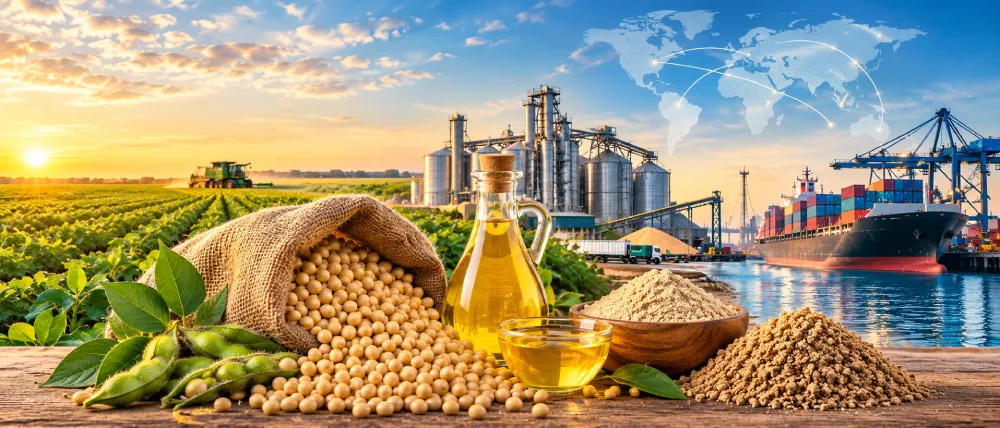
Soybean feeds two of the largest commodity streams on earth, edible oil and protein meal, and both begin with a single seed. Tracing the crop from planting through crushing to international markets explains why this legume holds such sway over world agriculture and why its price movements reach kitchens, feed mills, and fuel tanks alike.
Cultivating a Dual-Purpose Seed
Soybean farming opens with variety selection tuned to day length, since the plant flowers in response to photoperiod. Growers sow into warm, well-drained soil in late spring, drawing on the crop’s nitrogen-fixing root nodules to enrich land and reduce fertilizer demand. Through summer, pod set and seed fill decide both yield and oil content, while autumn harvest timing guards quality, moisture too high invites spoilage, too low risks shattering in the field.
Splitting the Seed Into Oil and Meal
Harvested beans enter the crush, where cleaning, cracking, and conditioning prepare them for extraction by pressing and solvent recovery. Roughly 18–20% of each seed emerges as crude oil, later refined into the clear cooking oil sold worldwide. The protein-dense meal that remains becomes animal feed, so every crushed seed supplies kitchens and feed troughs at once.
Where Soybean Oil Flows
Refined soybean oil moves into cooking oils, margarine, and processed foods, valued for a neutral taste and high smoke point. A rising share diverts into biodiesel, tying the crop to energy policy. This split between food and fuel means oil prices answer not only to harvest size but to renewable fuel mandates and crude oil swings.
The Nations Behind Supply
Brazil
Brazil leads global production and export, its widening cultivated area steadily reshaping trade routes.
United States
The U.S. combines vast production with advanced crushing capacity, keeping it central to both seed and oil markets.
Argentina
Argentina dominates processed exports, crushing enormous volumes along the Paraná River into oil and meal.
China
As the largest importer, China anchors demand, pulling cargoes across oceans and steering global prices.
How the Market Sets Prices
Soybeans and soybean oil trade on the Chicago Board of Trade under CME Group, letting farmers, crushers, and processors hedge risk. The crush spread, the gap between seed cost and the combined value of oil and meal, governs processor margins and signals when crushing pays. USDA WASDE reports reset supply expectations with each release, rippling through the complex.
What Drives Price Direction
- South American and U.S. growing-season weather
- Chinese import demand, the single strongest signal
- Biodiesel and renewable fuel policy pulling on oil
- The oil-versus-meal balance within each crush
- Currency and freight costs reshaping export flows
Because oil and meal share one seed, strength in one product reshapes the economics of the other, a link traders watch closely.
Tracking the Market With Real Data
For current soybean and soybean oil prices, rely on CME Group, USDA reports, and recognized commodity platforms.
Harvest forecasts and Chinese buying patterns matter far more than isolated price ticks for anyone planning purchases or positions.
The Crop Everything Else Is Measured Against
The soybean seed earns its standing by serving two giant markets simultaneously, feeding livestock through meal and nourishing kitchens and fuel through oil. Led in supply by Brazil, the U.S., and Argentina, and priced transparently on Chicago futures, it binds farmers, crushers, traders, and consumers across continents. For anyone following global agriculture, soybean oil and seeds remain the benchmark the rest of the sector references.
Related Articles
Mustard Oil and Seeds, Cultivation, India’s Leadership, and Regional Trade
Mustard carries a character no other oilseed shares, a sharply pungent oil tied to kitchen tradition and a seed whose trade orbits almost entirely around